“Over Yonder”: The Story of Yonder Prairie
 The year 2026 marks 20 years since TLC set foot on the land that would become Yonder Prairie Nature Preserve.
The name captures the beginning of the story: TLC staff member, Linda Balek, (now retired) suggested the name Yonder Prairie because the initial 40-acre parcel wasn’t near the road—it was simply “over yonder.”
The first visit, in 2006, brought together partners from the Soil & Water District, Natural Resources Conservation Service, McHenry County Conservation District, Army Corps of Engineers, Illinois Department of Natural Resources and TLC. Their work led to a conservation plan for West Woodstock Prairie, as Yonder was then known.
The plan highlighted the site’s natural significance and the need to protect it from development. That protection was not guaranteed. The land was purchased by a developer who had plans to build a subdivision. However, the development never occurred, the bank eventually foreclosed, and the property went up for sale at a sheriff’s auction.
In 2008, TLC raised the money and purchased the land from the people who bought it at the auction, turning a potential subdivision into an opportunity to put the partners’ conservation plan into action.
The preserve grew over the years. An adjoining 36-acre parcel along Rose Farm Rd. came up for sale, and three smaller acquisitions added important pieces: a two-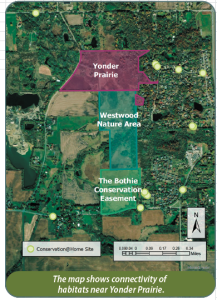 acre wetland parcel on Seneca Ct., where Blanding’s turtles have been seen; a one-acre triangular parcel, and land at the end of Trinity Ct. that provides an entrance from the neighboring subdivision.
Nearby 63-acre Westwood Park adds a protective buffer, while a 37-acre private conservation easement named “The Bothie” helps connect the neighboring natural areas. Together, these protected lands form a larger landscape where habitats can connect rather than stop at property lines.
Yonder Prairie was dedicated as an Illinois Nature Preserve in 2010. Nature preserve designation is reserved for the highest-quality remnant natural areas. These areas give a glimpse of an ecosystem that is incredibly rare and incredibly old. Remnant natural areas may have been grazed, but generally were never plowed or drained for agriculture.
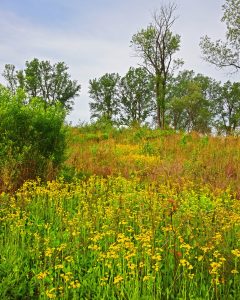
The highest-quality remnant sections of Yonder are wet/mesic prairie and sedge meadow, and are home to remarkable plant and animal communities.
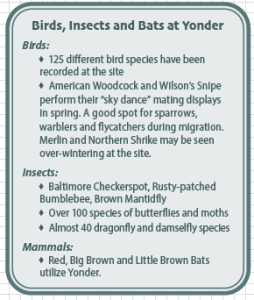
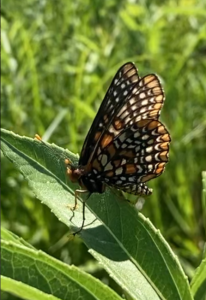
 For example, Daniel Pohl, TLC’s restoration ecologist, says he saw about 10 Baltimore checkerspots fluttering around in one area of the preserve. They are an imperiled butterfly that depends on an uncommon plant, white turtlehead, which grows at Yonder Prairie.
The preserve’s value lies not only in what you might see on a walk, but in how its habitats work together. Wetlands, prairie and oak savanna support different forms of life, while connected preserved lands provide room for wildlife to move.
The 2006 visit to Yonder began with a plan to save a threatened natural area. Now, the land “over yonder” is preserved for life, and is a reminder of the benefits of collaboration when it comes to conservation.