


FarmHer Profile: Emily Kessler, Prairie’s Edge Farm
Farm name and location: Prairie’s Edge Garden, Harvard, IL
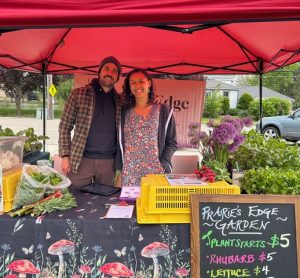
Years farming: Four years. My husband, Derek, started the farm in 2011, and I dabbled in helping him beginning in 2019. He lured me in with ducklings and planting sunflowers, and I was hooked. We officially joined forces for the 2022 growing season when I moved back to the area and went all in with a CSA.
What are you growing/producing? Best-seller? We grow seasonal vegetables, flowers, herbs and increasingly native plants and seeds using regenerative and no-till practices. At market, we love selling root crops, peppers, greens and whatever else the garden is throwing at us, but our flower bouquets and garlic are probably our best sellers. I love that the farm can produce both food and beauty.
Why farming? My three great loves in life have always been nature, food and flowers. If I had put those three things together sooner, I probably would have found farming a lot earlier.
There is something deeply meaningful about growing food and flowers for other people. I truly don’t think there is a more vital profession than farming, yet most people rarely know a farmer personally. Food is one of the most important things we interact with every single day, and I love being part of that connection.
I also just love to eat. Nothing beats a good meal made with beautiful ingredients and shared with great company. Farming gives me a sense of purpose, teaches me patience, and keeps me connected to the rhythms of the earth. There is something deeply satisfying about touching the soil, sowing a seed, and waiting to see what follows.
How do you feel about being a woman farmer? I think women bring an incredible combination of observation, intuition, persistence and nurturing to this work. Women farmers may still seem underrepresented to the general public, but I’m proud to be part of such a fantastic community of women growers in our area.
There is also a part of me that loves being a woman in a space that has traditionally been thought of as belonging to men. It feels powerful. I like knowing that the women who came before me are somehow part of this story, too.
Mostly, though, I think my six-year-old self is absolutely thrilled that I still wear overalls and play in the dirt.
Biggest win/what makes you happiest? I’m happiest in the quiet moments in the garden. Harvesting flowers at dawn or dusk in that soft golden light, with birds chattering overhead and hummingbirds zipping past, is pure bliss. I love the first blossoms of spring, the smell of fresh rain, and that little chill in the air when autumn starts creeping in. (Miss me with the dead heat of summer and the mosquitoes, but you have to take the good with the bad.)
There are so many tiny moments in the garden that I would miss if I wasn’t paying attention. Farming constantly asks you to slow down, observe and notice what is happening around you.
I also absolutely love hearing what happens to the food and flowers after they leave the farm. Tell me what you made with your CSA vegetables. Send me a picture of the flowers on your kitchen table. Freak out over a particularly beautiful bouquet. I’m all ears.
Seeing something we created from a tiny seed bring another person joy is what it’s all about. And honestly, the community we’ve found through farming has been one of the best parts of the journey. We’ve met gardeners, foodies, flower lovers, neighbors, fellow farmers and so many people trying to do good in the world. Having regular customers we genuinely look forward to seeing, and who look forward to seeing us, is the absolute bee’s knees.

 Biggest challenge?
The hard times when everything seems to go wrong and you wonder why you had this insane idea in the first place.
It’s 95 degrees, the flies are biting, you’ve misplaced your weeding tool for the tenth time, the deer have crashed through the corn again, and the rabbits/chipmunks/ground squirrels (take your pick) just ate the tops off an entire tray of flowers you just planted. Sometimes the biggest challenge is simply finding the resilience to keep going when burnout sets in.
I think social media can make farming look much more romantic and put-together than it really is, so I appreciate when farmers are willing to show the messy parts, too. Farming is hard work. Plants die. Things go sideways. The weather doesn’t care about your crop plan.
How are you thinking about your farm in the future?
My nature is to plan, so the future is always somewhere in the back of my mind. We want to build a farm that is sustainable for us and works with nature as much as possible.
We’re especially interested in growing more of the native seed we collect and learning more about the prairie plants that surround us. We are fortunate to farm in the middle of a restored native prairie, and we feel like there is an enormous amount of knowledge there waiting for us if we pay close enough attention.
We’d also love to expand our value-added production, eventually become Certified Naturally Grown or pursue organic certification, and move toward a more closed-loop system that could include poultry for eggs.
Long-term, my husband and I hope to inherit the family farm and keep it going for generations. I currently work an off-farm job, so one of my biggest goals is to eventually devote myself to the farm full time. The list of projects and ideas is, admittedly, very long.
“Regenerative / ecological” practices on farm?
We farm without pesticides or herbicides and use no-till and soil-building practices whenever possible. This year we put a particular focus on water conservation by investing in drip irrigation and began establishing hedgerows around the garden.
We are surrounded by nearly 100 acres of native prairie that my father-in-law has lovingly restored over several decades. This year we added native trees and shrubs to our own farm and plan to continue expanding them to help mitigate wind, create habitat, and bring more beneficial birds and insects closer to the garden.
For us, ecological farming is about understanding the relationships between everything: the soil, plants, insects, birds, water, weather, and the people who depend on the land.
Anything else you want to share?
I am deeply grateful to my in-laws, the Kesslers, for giving us access to this land and the opportunity to build something here. I’m equally grateful that I get to do this alongside my husband.
The support we’ve received from our friends, family, customers, fellow farmers, and organizations like TLC has meant so much to us. Farming has taught me a lot about abundance, sharing, kindness, resilience, and reciprocity.
It isn’t an easy life, but it is a darn rewarding one.


