


Boloria Meadows, Bull Valley
Located within the Boone Creek watershed, the 56.5-acre Boloria Meadows Nature Preserve is home to several natural communities that were once widespread, including three types of wetlands. The fen, sedge meadow and wet prairie are saturated by mineral-rich groundwater that is filtered and enriched as passes through gravel in the surrounding hills. This provides habitat for unique plant species like fen betony and Grass of Parnassus. The woodland and savanna are home to numerous ancient oak and hickory trees as well as unique species like the pileated woodpecker and Southern flying squirrel.
The site got its name from the silver-bordered fritillary butterflies (Boloria selene) and also contains a healthy population of the uncommon Baltimore Checkerspot butterfly. Thanks to the diversity of plant life, more than 35 types of butterflies and moths, 25 species of dragonflies, and 50 bird species are found at Boloria Meadows.
This site will be closed periodically for hunting from October through January
Concannon Conservation Area, Woodstock
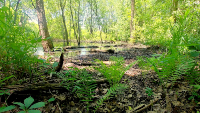
Little pockets of natural habitat nestled within our cities and towns provide great benefits to small creatures like birds, butterflies and frogs. Concannon Conservation Area is only two acres, but it is part of a ribbon of greenway that winds through Woodstock. A short, wood-chipped trail circles a vernal pool and offers a peaceful place to sit on a bench or go salamander hunting. A small sign marks the entrance to the trail.

Crowley Oaks Preserve, Harvard
Crowley Oaks is an 83.5-acre natural area that includes remnant oak woods, a headwater stream for one of Chicagoland’s highest-quality streams (Piscasaw Creek), and 14 acres of sedge meadow and wet prairie habitat. The site includes nearly 50 acres of white oaks, bur oaks and hickories that are over 200 years old. This site is part of a larger oak woodland that is nearly 200 acres in size, making it one of the largest remaining in the county. The land is next to several other natural areas, providing habitat connections for pollinators and other wildlife.

Eckert Cemetery Prairie, Woodstock
The Eckert Cemetery Prairie was a portion of the family farm donated to the local community by the Eckerts in 1852 to use as a burial place for local residents.
The last Eckert to live on the adjacent farm was Herbert Eckert (d. 1965), who grew up on the farm and loved the land. He was also a naturalist and recognized the importance of preserving the cemetery as native prairie. To this end he conducted prescribed burns every year.
His children, Edna Eckert Steadman, Albert Eckert, and Eleanor Eckert Gerloff, made concerted efforts to find an appropriate entity to steward the land long-term. Their children, in turn, have worked with TLC to ensure this ecological and historical landmark is preserved for the future.
Gateway Park, Harvard
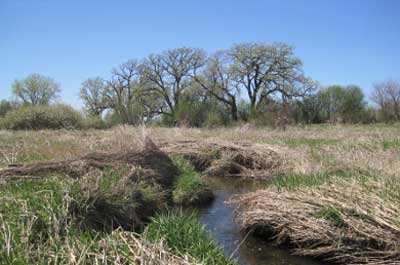
When TLC acquired this site we discovered a true gem: the county’s largest White Oak, with oak limbs sprawling and reaching for the abundant sunlight. In the buckthorn-free woodland and wetland, birds such as the indigo bunting and swamp sparrow thrive.

Hennen Conservation Area, Woodstock
Phyllis and Tony Hennen acquired this land in the early 1970s, planting thousands of native hardwood seedlings in land that once was farmland. In 2008, the Hennens placed a conservation easement on the 25-acre property, protecting it from development. In 2009, they donated this site to the City of Woodstock for use as a public park, and The Land Conservancy of McHenry County (TLC) moved its offices to the farmhouse shortly afterward.
Over the decades, the land has been turned into a wild and natural place where approximately two miles of trails lead you through a sea of wildflowers and groves of trees, including majestic oaks. A pond on the property is home to ducks, turtles and frogs.

Irish Oaks Nature Preserve, Harvard
Named after the abundance of Irish immigrants who moved to the region during the 1880s, Irish Oaks is a 40-acre wetland and oak savanna. In 2021, Irish Oaks was dedicated as an Illinois Nature Preserve because it is the best remaining example of a dry-mesic oak savanna in this part of Illinois.
Here, giant white oaks and bur oaks dot the while prairie and sedge meadow wetlands fill the spaces between the trees, offering diverse habitat for a wide range of birds including flickers, sedge wrens and bobolinks. Irish Oaks is home to native plants like ferns, club mosses and orchids.

Thompson Road Preserve, Bull Valley
The 275-acre Thompson Road Preserve includes peatland, oak woods, glacial topography and five miles of hiking and horse trails located at an important headwaters area of Boone Creek, one of the most important ecological treasures in Northeast Illinois.
As the former farm fields are restored to wetland, prairie and savanna habitat in the years ahead, the preserve will safeguard the cool, clean water that flows to the creek, and thus safeguart the species that need the hig-quality, cold water stream.
12,000 years ago, retreating glaciers left behind sand-filled ridges and a backwater basin. Today, those ridges are home to 13-line ground squirrels, groundhogs and badgers who dig burrows into the sandy soil. Until recently, the basin was farmed. Over the coming years it will be restored to wetland habitat that will benefit insect, amphibian and bird species. The diverse habitat is used by over 130 species of birds including 20 species of warblers, Northern harriers, Northern shrike and a variety of owls.
Wolf Oak Woods, Bull Valley
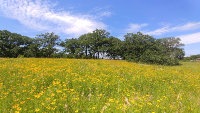
Wolf Oak Woods is named after the Wolf Oak, a large bur oak that is believed to be more than 350 years old. The sprawling nature of its heavy limbs cause them to swoop down to touch the ground and grow back up again toward the light. The Wolf Oak, clearly visible from Route 120, has become a culural icon and ecological relic.
Beyond the Wolf Oak tree, the preserve includes 30 acres of ecologically intact wetland and oak woodland. In spring, you will see a carpet of spring wildflowers such as Dutchman’s breeches and shooting star. In the summer, a restored prairie near the Wolf Oak bursts with summer wildflowers to create pollinator habitat.
Yonder Prairie, Woodstock
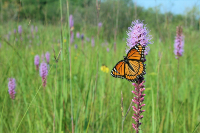
Yonder Prairie Nature Preserve is a 70-acre wet prairie, sedge meadow and oak savanna complex. Prior to the purchase of this land in 2008, it was deemed the highest quality unprotected natural area in the county. Walking through this site, you’ll pass by pockets of remnant wet prairie – areas that rarely have standing water, but the soil is saturated and moist most of the year. The adjacent oak savannas and woodlands have been transformed from buckthorn thickets into native habitat for birds, mammals and pollinators. One-quarter of the dragonfly species in Illinois are found here.